Question
You have the Azure environment shown in the exhibit.
You have virtual network peering between Vnet1 and Vnet2. You have virtual network peering between Vnet4 and Vnet5. The virtual network peering is configured as shown in the following table.
| Virtual network | Traffic to remote virtual network | Use remote gateway | Allow gateway transit |
|---|---|---|---|
| Vnet1 | Allow | None | Enabled |
| Vnet2 | Allow | Enabled | None |
| Vnet4 | Allow | None | Enabled |
| Vnet5 | Block | Enabled | None |
For each of the following statements, select Yes if the statement is true. Otherwise, select No.
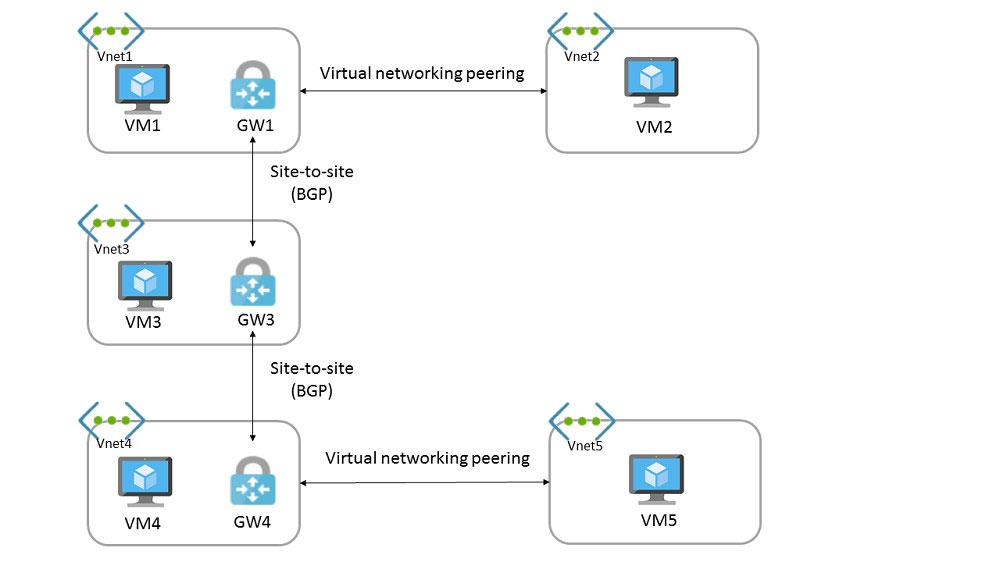
Explanation
Statement 1 (Yes): GW1-GW3 and GW3-GW4 are Site-to-Site connections with BGP, and BGP propagates the routes each gateway learns to its other peers, so GW3 provides transit routing between Vnet1 and Vnet4. Statement 2 (Yes): Vnet1 allows gateway transit and Vnet2 uses the remote gateway, so Vnet2's prefix is advertised by GW1 over BGP and reaches Vnet4 through GW3, and VM2 can reach VM4 the same way. Statement 3 (No): although Vnet5 uses GW4 as its remote gateway, its peering is set to Block all traffic to the remote virtual network, which stops traffic flowing from Vnet5 over the peering, so VM5 cannot exchange traffic with Vnet4 or anything reached through GW4, including VM1.
