Question
Your network contains an Active Directory Domain Services (AD DS) domain named contoso.com. The domain contains the VPN servers shown in the following table.
| Name | IP address |
|------|------------|
| VPN1 | 172.16.0.254 |
| VPN2 | 131.10.15.254 |
| VPN3 | 10.10.0.254 |
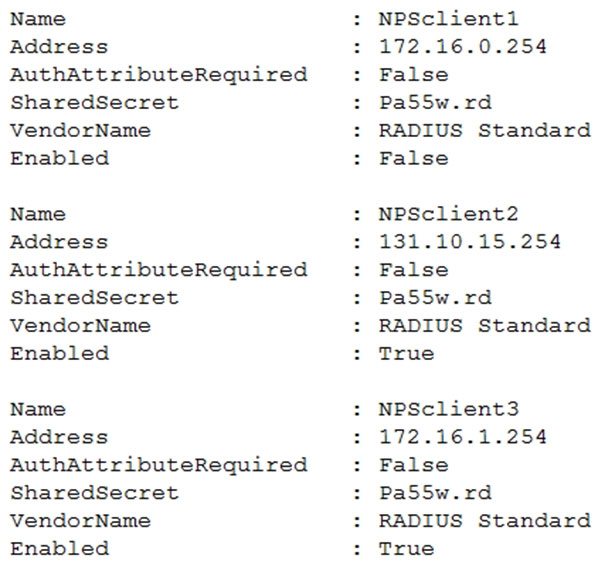
You have a server named NPS1 that has Network Policy Server (NPS) installed. NPS1 has the RADIUS clients shown in the following exhibit.
VPN1, VPN2, and VPN3 use NPS1 for RADIUS authentication. All the users in contoso.com are allowed to establish VPN connections.
For each of the following statements, select Yes if the statement is true. Otherwise, select No.
NOTE: Each correct selection is worth one point.
Explanation
Statement 1 (No): NPSclient1 has the address of VPN1 (172.16.0.254) but Enabled is False. NPS ignores requests from a disabled RADIUS client, so authentication through VPN1 fails.
Statement 2 (Yes): NPSclient2 matches VPN2's address (131.10.15.254), is enabled, and uses the shared secret, so NPS1 processes VPN2's requests and users can authenticate.
Statement 3 (No): NPSclient3 is enabled but its address is 172.16.1.254, not VPN3's 10.10.0.254. No RADIUS client is defined for VPN3, so NPS1 discards its requests.
